


Every coastal city, port, and response team starts the day knowing the weather forecast. Mohamed Ismail wants them to start it knowing what is drifting toward them too, whether that is sargassum, debris, oil or a shipping container in the water.
Mohamed is the founder and CEO of Castus Technologies, a Miami-based company developing predictive ocean intelligence for disasters and response. Castus combines ocean physics, satellite observations, and artificial intelligence to forecast where floating material will move, so teams can plan where to go and when.
I spoke with him about the problem Castus is built to solve, how the technology works, what came out of their August 13 pilot off Fort Lauderdale, and his vision for forecasting the ocean’s surface the way we forecast the weather.
Blue Tide: What problem is Castus built to solve, and why has it been so hard to crack historically?
Mohamed Ismail: The ocean moves, and everything floating on it moves too. A sargassum mat, an oil slick, a field of plastic or a person in the water is never where you last saw it. So most of the time and money in ocean response goes into searching, not responding. Crews burn fuel and hours covering huge areas, hoping to find the target before it reaches a reef or beach.
Here in South Florida, sargassum shows what that costs. We usually meet it only when it lands. By then it is rotting on the sand, it smells like rotten eggs, and it keeps visitors away from the hotels, restaurants and bars that depend on our beaches. Miami-Dade taxpayers spend nearly $4 million a year just on tractors to clear it from the shore, and what gets gathered goes to landfill.
Why has it been so hard? Every piece of the puzzle existed on its own. Ocean models describe currents, but not where a specific mat is. Satellites can spot a mat, but only in a snapshot, and clouds get in the way. Nobody had joined them into something a boat captain can act on: go here, at this time, with this level of confidence. That is the gap Castus fills.
BT: Walk us through how the technology works. If someone were using it in the field, what would that look like in practice?
Mohamed: Castus is a forecasting platform for things that float. It combines four inputs: ocean currents from global models, wind, how the object sits in the water, and satellite imagery. Sargassum rides the surface differently from an oil slick or a plastic bottle, so the physics changes with the target. A Bayesian probability engine, which is what our patent covers, fuses those inputs and updates the forecast as new observations come in.
The output is not a dot on a map. It is a target zone, a time window and a confidence level. That is what a crew needs to plan a trip.
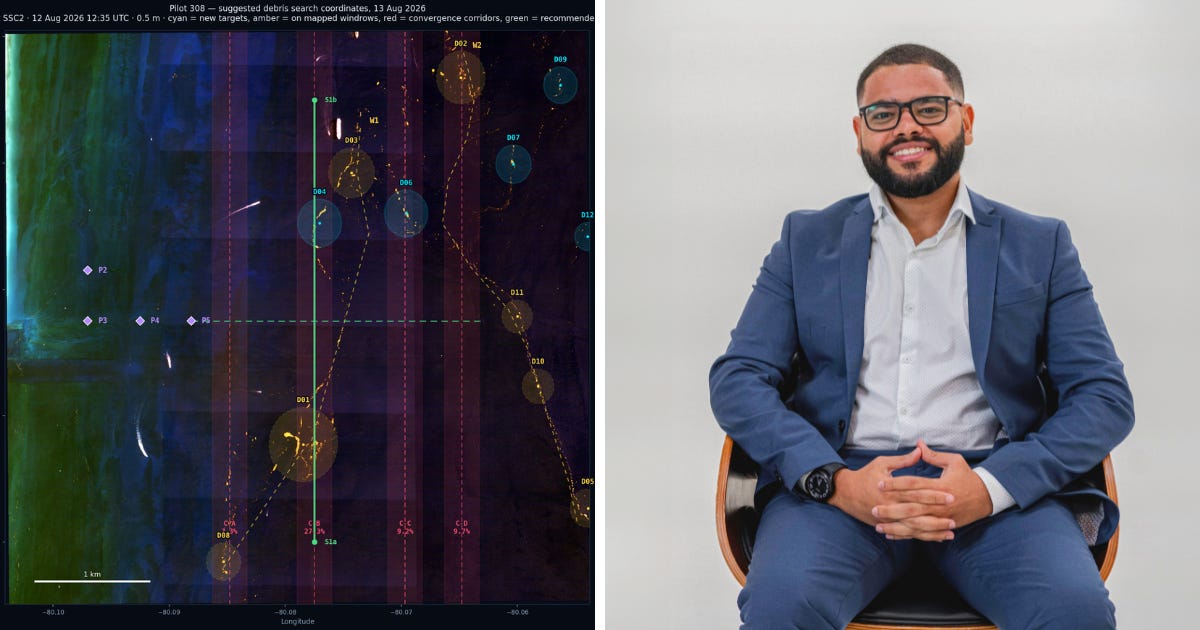
In the field it looks simple. Say a city or a cleanup team wants to get ahead of sargassum heading for its beaches. A day or two out, Castus flags where the mats are likely to be. We check those areas with high-resolution satellite images through our contract with Planet Labs. Then the drift model projects where the mats will be when the boat can get there. The crew leaves the dock with coordinates and a time window instead of a hunch, and goes straight to the target.
Sargassum is our first use case. Marine debris runs on the same engine, and we are developing oil-spill and floating-object forecasting on the same core.
BT: You ran your first pilot study on August 13 this year. What were you testing, and what did you find?
Mohamed: We were testing one simple question: can a forecast become a place a crew can actually reach?
We ran it over three days off Fort Lauderdale:
August 11 and 12: Our model scanned a zone reaching 12 miles offshore from the 15th Street Boat Ramp and flagged high-probability sargassum hotspots.
August 12: We tasked a high-resolution Planet Labs satellite over those hotspots. The images showed several large sargassum patches inside our predicted areas.
August 13: Our drift model projected where those patches would be that day. The team sailed aboard the DISCOVERY Vessel Bay Browser with the International SeaKeepers Society and Debris Free Oceans, with program support from The Continuum, and visited several predicted coordinates.
The sargassum was there. We located more than 70,000 square meters of it, about four miles offshore, and documented it with drone footage, on-water video and underwater observations. The crew also recorded marine debris along the way. What we learned is that the whole chain works end to end: model, satellite, forecast, boat.
BT: Who are your primary customers, and how does the business model work?
Mohamed: Our customers are the organizations that pay today for the cost of searching, including coastal agencies and cities, cleanup operators, and marine response and service companies. Our first support came from NOAA, through a $75,000 Technology Development and Commercialization award that helped fund our field work.
The core business is software. Customers subscribe to forecasts for the stretch of ocean they care about, priced by the size of that area, how often they run missions and the level of detail they need. Agencies that want the platform inside their own systems take an enterprise license, and partner platforms can buy our data through an API.
Miami is where we want to go further than forecasting. Sargassum is not just a nuisance. It is a raw material that we currently pay to bury. Our next step is a coalition for a zero-waste sargassum supply chain in Miami, with three links:
Forecast and collect. Castus tells crews where and when sargassum will arrive. Our collection arm, working as a contractor, intercepts it in the water close to shore before it lands, within the rules that protect sargassum as habitat.
Process. A processing partner turns that fresh sargassum into raw material. Sargassum raked off the beach is mixed with sand and already rotting; sargassum caught in the water is a cleaner, better raw material.
Sell. A marketplace promotes products made from sargassum, so every ton collected has a buyer.
In this model, beach managers pay for prevention instead of cleanup, and processors get a steady, predictable supply. Hotels and beachfront businesses keep their beaches open and their guests happy. The county spends less on tractors and landfill. And a problem that costs South Florida every season starts creating local products and jobs.
Miami-Dade is already testing ways to turn sargassum into fertilizer and building materials with the Miami-Dade Innovation Authority. What that work needs is a reliable supply of clean sargassum, and forecasting is what makes that supply possible. We are starting to form this coalition now, and we want hotels, beachfront businesses, processors, makers and the county at the table.
BT: If Castus reaches its full potential, what does ocean monitoring and tracking look like in ten years?
Mohamed: In ten years, I want the ocean’s surface to be forecast the way we forecast the weather. Every coastal city, port and response team should start the day knowing what is drifting toward them, where it will be and when: sargassum, debris, oil, a lost container or a person in the water.
That changes the work itself. Today we search, and we clean up after the damage is done. Tomorrow we intercept. Boats leave the dock knowing where to go. Oil is met before it reaches the mangroves. Sargassum is collected before it touches the sand.
It also changes the economics. Sargassum stops being a cost we bury and becomes a resource that supports local businesses and jobs. If we get the Miami model right, forecast, collect, process and sell, we can take it to every coastline that faces the same seasons, from the Caribbean to the Gulf.
I want Miami to be where that starts. This city lives with the ocean every day, and it should lead in understanding it.
Castus is forming a Miami coalition to turn sargassum from a seasonal cost into a local resource, and it’s looking for partners. Hotels and beachfront businesses, cities and county programs, sargassum processors, makers and designers, researchers and investors can learn more at castus.ai and reach Mohamed directly at m.said@castus.ai.
This article is part of a spotlight series on Blue Tide, which shares stories about the people and startups shaping ocean technology. If you know someone who would like to be featured, send me an email.