


Welcome back. This week we're looking at a podcast series exploring how technology is reshaping ocean industries, a Florida-based company rethinking what sargassum is worth, and a venture program in Latin America closing the gap between ocean innovation and the industry partners that can deploy it.
🎙️ The Natural Justice Podcast launched a series on ocean intelligence
The Natural Justice Podcast brings the stories behind our seafood to you. Through a range of series, it explores the experiences of people working across the seafood sector (fisheries and aquaculture), alongside the environmental laws aimed at protecting our oceans and their resources.
The podcast recently launched its third series, Ocean Intelligence, which dives into the use of technology and AI in the ocean space, from fisheries and aquaculture to other ocean industries such as shipping and mining.
The podcast is produced by Natural Justice, a sustainable seafood advisory founded in 2018. The consultancy works at the intersection of environmental law, science, and policy, supporting seafood producers, NGOs, and governments on sustainability and legal compliance.
Ocean Intelligence surfaces questions that rarely get dedicated airtime, like how AI tools are being adopted in practice, what the legal and data implications look like, and where the gaps remain.

🌿 Seaweed Greens is turning sargassum into a soil input
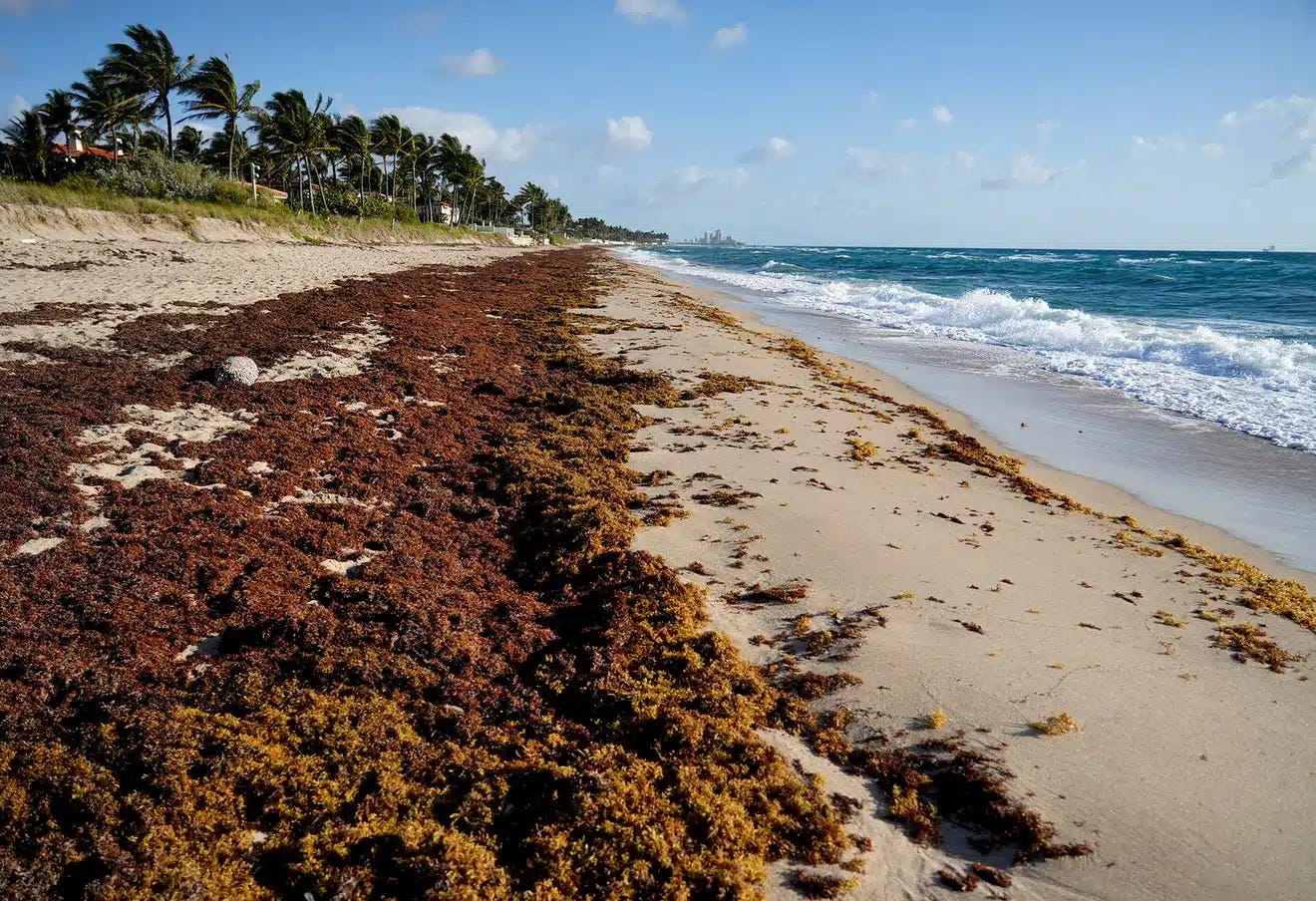
Sargassum has shifted from a seasonal nuisance to a persistent crisis, especially across the Caribbean. By mid-2025, satellite tracking put the volume drifting across the region at over 37 million tons, with San Pedro, Belize alone removing over 100 tons in a single week.
Most of the current conversation remains centered on disposal or energy, which misses the long-term opportunity. Florida-based Seaweed Greens doesn’t approach sargassum as waste or an energy input. Their focus has been on rapid transformation, removing salt, sand, plastics, bacteria, and heavy metals including arsenic in under ten days, so it can be safely reintroduced into biological systems like permaculture and soil regeneration.
The company can process sargassum at scale, 100 tons a day, and has the engineering background to turn this massive inundation into useful outputs like fertilizer.
The timing adds another dimension. Around a third of global seaborne fertilizer trade typically passes through the Strait of Hormuz, which has been nearly entirely closed since late February, sending prices sharply higher at the start of planting season. A domestic source of soil amendment, produced from material currently treated as a liability, could offer more supply chain resilience.
🌊 Reciprocal's Upwell program is bridging ocean startups with industry in Latin America
Reciprocal is a Latin American climate venture platform that builds, invests in, and supports startups with positive environmental impact across the region. One of its programs, Upwell, is designed to move ocean innovation startups in Latin America and the Caribbean past the hardest commercialization step, real-world deployment.
Over 80% of ocean accelerators operate out of the Global North, and ocean startups in the region typically lack routes to the corporate partners they need. Latin America and the Caribbean, with significant cost advantages in early-stage R&D and ocean-based economic activity generating over US$400 billion annually in the Caribbean alone, is a compelling place to close that gap.
The program targets startups with early technical validation who need structured industry access to move from prototype to pilot. Reciprocal works with industry partners to define deployment challenges, match startups to relevant partners, and provide commercial and technical readiness support throughout.
Upwell is part of a broader pattern worth watching. From the Nordics to Southeast Asia, ocean-focused acceleration and deployment programs are multiplying, each shaped by the coastal and maritime realities of their region.
That's it for this week. If you have a story, company, or initiative you'd like to see featured in a future edition, reach out, always love to hear what's happening in the space.