


Happy Earth Day! This year's theme is Our Power, Our Planet, and this edition leans into it fully. All three stories sit at the intersection of the ocean and clean energy, including the state of ocean energy globally, where tidal power could realistically be generated, and one company rethinking data centers from the seabed up.
⚡ The state of ocean energy
The International Energy Agency’s ocean program published its annual report for 2025, drawing on activity across 20 member countries. The most notable shift shared is that ocean energy devices are spending more time in the water. Rather than short one-off trials, more projects are moving through repeated cycles of deployment, learning, and redeployment. Grid-connected tidal installations in the UK, China, and the Faroe Islands have now accumulated years of continuous operation, and that track record is what the sector has needed to begin building investor confidence.
The report also captures a broadening of how ocean energy is being applied. Projects are increasingly paired with desalination, hydrogen production, aquaculture, and island microgrids, making them more economically viable in remote coastal settings where energy is expensive to deliver. On the policy side, the EU has formally recognized tidal and wave energy as part of its clean industry strategy, and several countries updated their national plans and permitting rules in 2025 to make it easier to run demonstration projects.
🗺️ Mapping the ocean's tidal potential
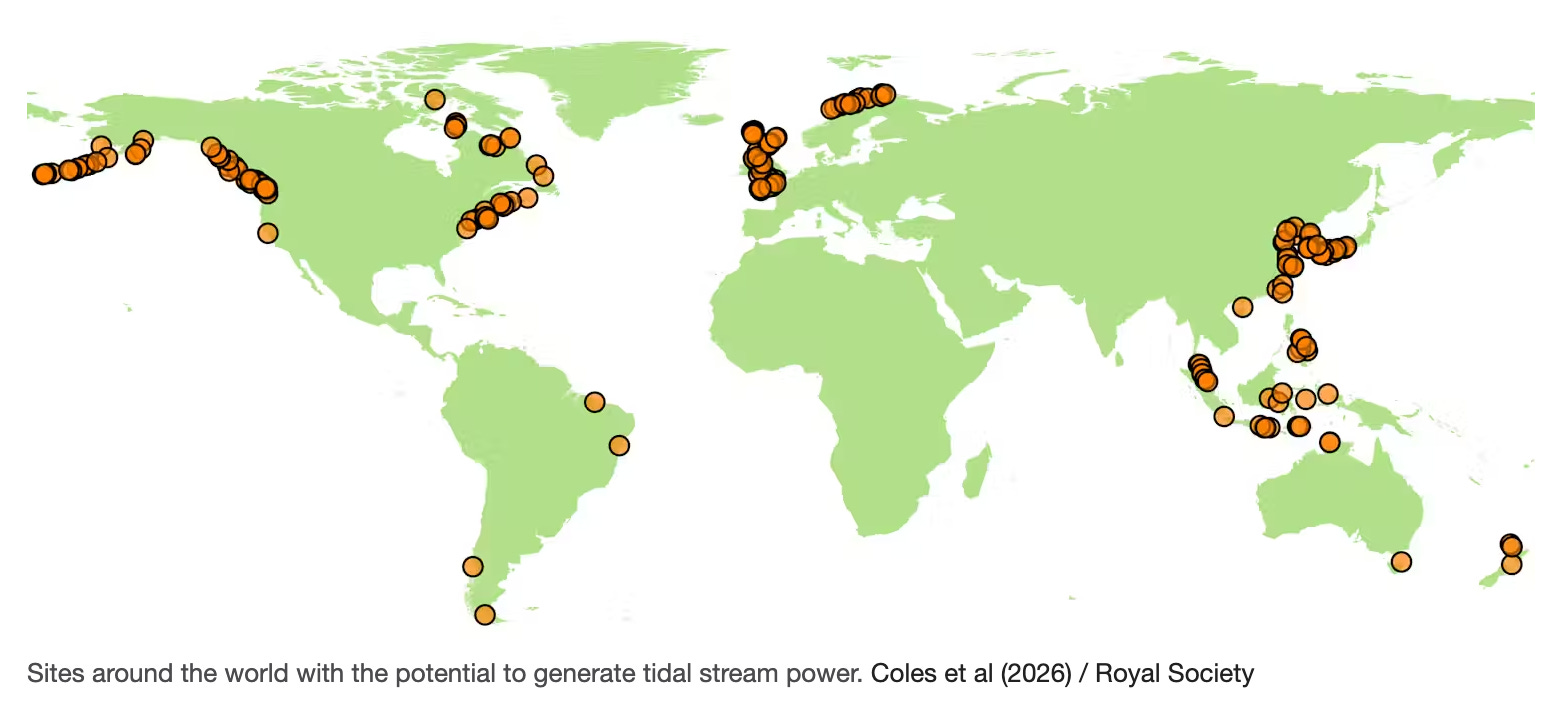
A new study published in the Proceedings of the Royal Society mapped 426 sites across 19 countries where underwater tidal turbines could realistically generate electricity. The technology works much like a wind turbine, only on the seabed, powered by the twice-daily movement of tides. Researchers estimate that the 90 best-studied sites alone could produce around 110 terawatt-hours of electricity per year, roughly equal to Portugal’s annual demand. The countries with the largest resources include the US, UK, Canada, New Zealand, China, and Indonesia.
What makes tidal energy stand out is predictability. Unlike wind or solar, tidal output can be forecast years in advance, making it a reliable complement to weather-dependent renewables. More than half of the global resource sits within just six locations, including the Pentland Firth in Scotland, the Alderney Race between France and the Channel Islands, and Canada’s Bay of Fundy. The UK and France have already committed to installing at least 400 megawatts of tidal capacity over the next decade, and the research gives developers a clearer picture of where the best opportunities lie.
🌊 Marisyn's wave-powered data centers
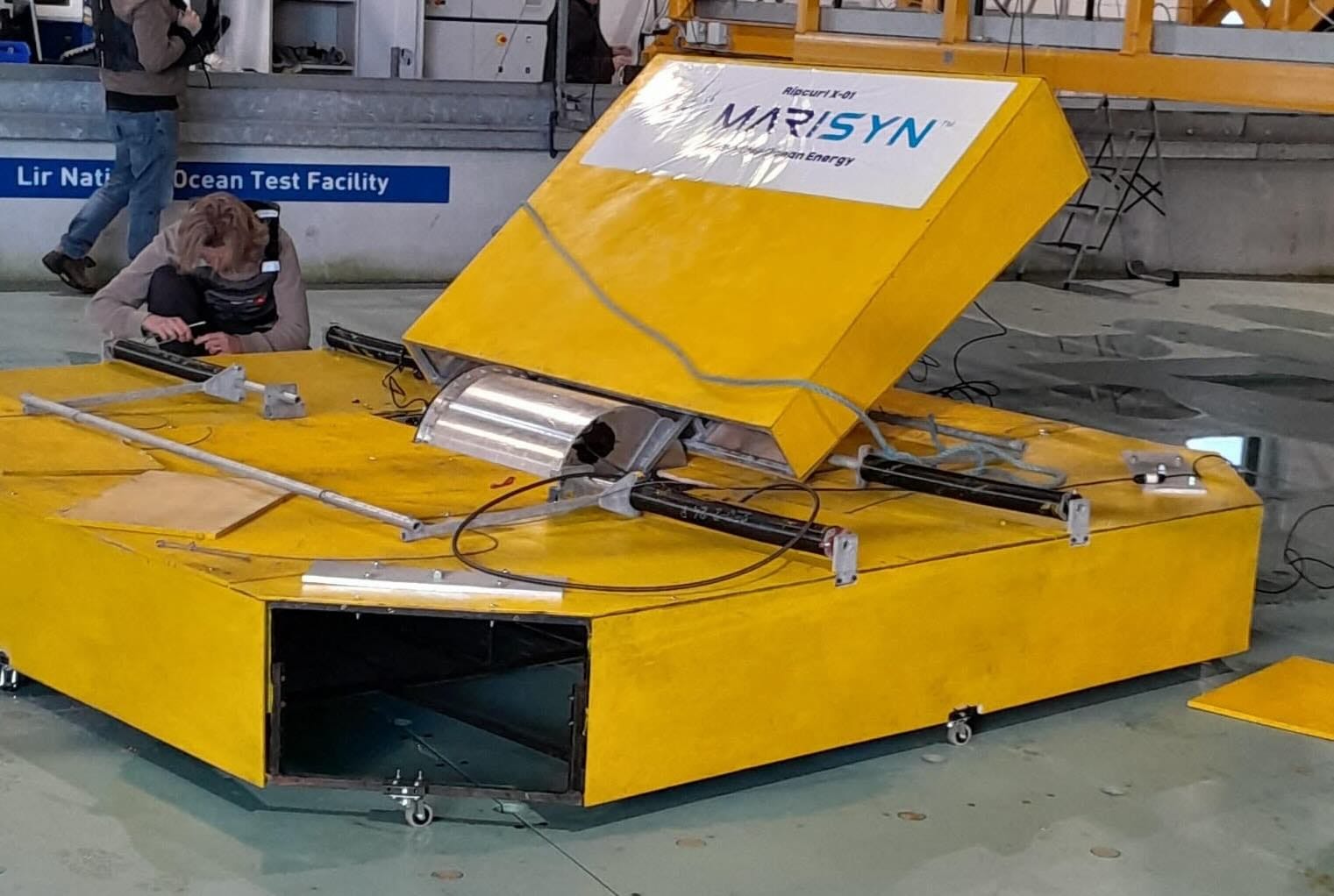
Data centers consumed approximately 4.4% of total U.S. electricity in 2023, with projections indicating a rise to between 6.7% and 12% by 2028, according to a U.S. Department of Energy report. The existing power grid and available land are not built to keep up with that kind of growth. Founded in 2024, Marine Synthesis Inc. (Marisyn) is building an alternative – data centers housed in underwater pods, powered directly by ocean wave energy, and with no grid connection required.
One added benefit of going underwater is cooling. Keeping servers from overheating is one of the biggest energy costs for land-based data centers, but seawater does that job naturally. Waves off U.S. coasts can theoretically generate more than half of the country’s total annual electricity needs, and Marisyn is drawing on over 25 years of accumulated marine energy development to put that resource to work.
Learn more about Marisyn here.
That's it for this week. If you have a story, company, or initiative you'd like to see featured, reach out.