


Last week, I attended two blue economy conferences: One Ocean Week in Seattle and the Blue Economy Investment Summit in Portland, Maine. Both regions are emerging as key innovation clusters, and it was interesting to see the themes that surfaced.
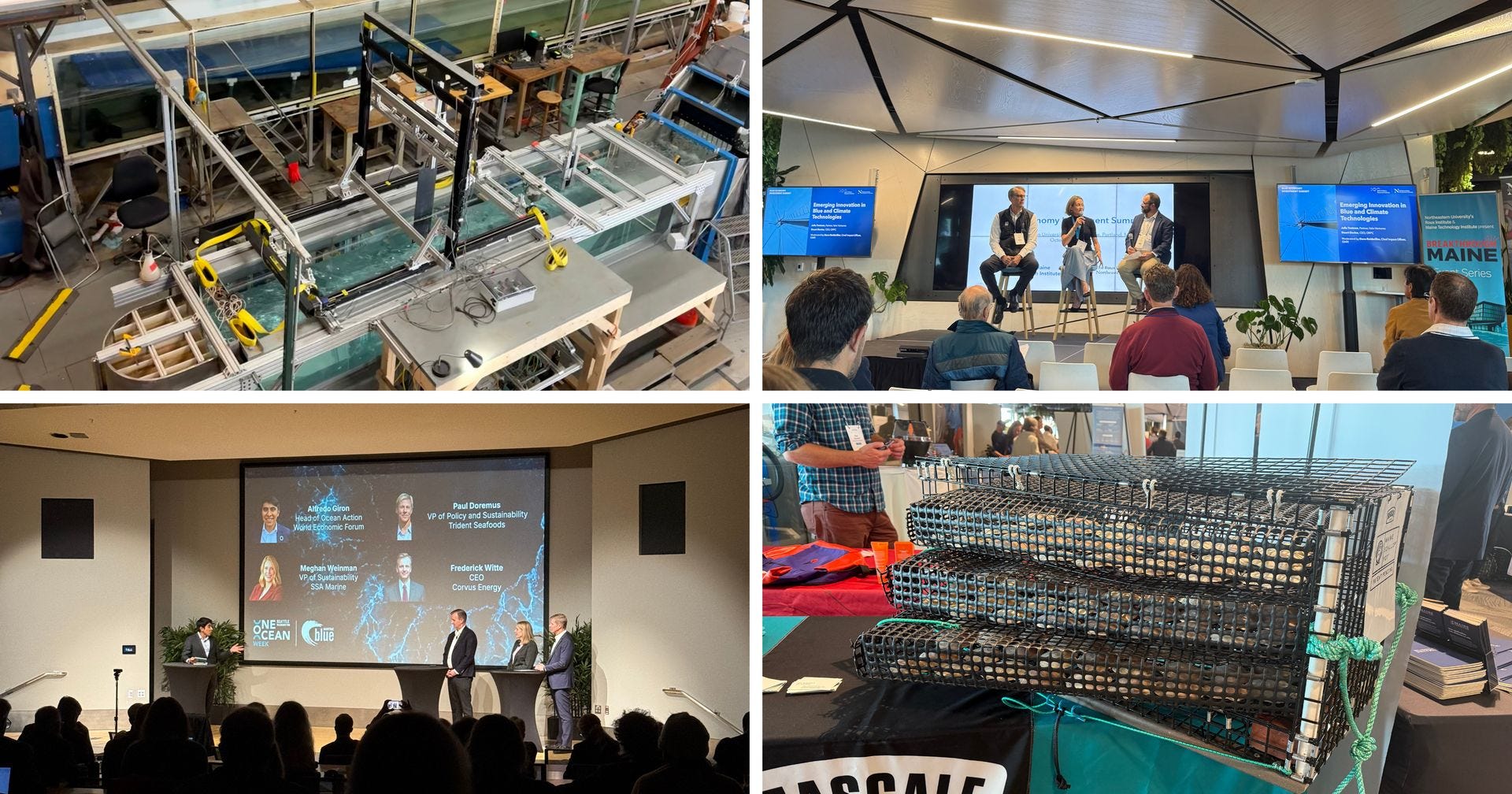
Some snaps from One Ocean Week and Blue Economy Investment Summit.
🤝 Collaboration is the superpower behind blue economy innovation.
I’ve never seen this level of collaboration in an industry before. Private companies, government agencies, universities, nonprofits, global diplomatic partners, and investors are working hand in hand to move the industry forward.
And it’s not just regional. Initiatives like 1000 Ocean Startups unite members around the world to fund at least 1,000 ocean-focused startups by 2030.
The phrase “a rising tide lifts all boats” clearly sits close to the heart of many people in the industry.
🌊 We’re entering the era of marine energy, and the tailwinds are strong.
Marine energy (wave and tidal) is having a real moment, especially in the U.S., where funding that once flowed into solar and wind is being redirected toward marine energy.
Unlike other renewables, marine energy is highly predictable and reliable. That predictability is why the current U.S. administration included dedicated funding and tax credits tied to what marine energy could mean for national energy security.
And the industry is reaching a research and development phase where costs can drop, meaning it could soon compete with the traditional grid.
🚢 The U.S. is constantly competing with China, and the maritime sector is part of that race.
The Big Beautiful Bill authorizes almost $2B to revive shipbuilding in the U.S., posing a huge opportunity for those seeking federal funding.
But many are skeptical and see the time horizon for this to play out at a minimum of 10 years. Because of labor costs it’s much more expensive to build a ship in the U.S. versus China, who currently dominates the industry.
The U.S. no longer has the skilled workforce (like welders) required for large-scale shipbuilding, so rebuilding that talent pipeline would require extensive training.
This theme also came up in a panel comparing fish processing between the U.S. and China. Currently, most fish caught in Alaska are shipped to China for processing before making their way back to U.S. shelves because labor is so much cheaper.
💸 The U.S. and Europe view blue economy investment differently.
A team member from Hatch Blue (European-based VC) pointed out that in the U.S., the blue economy is often viewed primarily through an impact lens, something philanthropic or mission-driven. In Europe, it’s increasingly viewed as an economic engine that also delivers positive impact.
That difference in mindset matters. Today, less than 1% of global funding goes to the ocean, despite research showing that every $1 invested generates $5 in economic returns over time.
🦞 A deeper respect for fishing communities and working waterfronts.
Whether in Maine (lobster) or Alaska (salmon), fishing is industry, identity, heritage, and community. And this way of life is under threat.
The Gulf of Maine is warming three times faster than the global average. Fish stocks are shifting north into Canada for colder water or farther offshore where harvesting becomes more difficult and more dangerous. Storms are intensifying, putting fishermen’s lives on the line.
Coastal cities are also balancing development pressures with the need to maintain working waterfronts, spaces that allow fishermen to keep doing what their families have done for generations.
I’ll be diving deeper into most of these themes in future Blue Tide issues. If you know a founder, researcher, fisherman, or policymaker working on any of these, please reach out, it would be great to connect.
Also, vote in the poll below and let me know which topic you’d like to read more about next.
Which topic should I dig into next?
Login or Subscribe to participate
🦭 Zané