


Over 90% of global trade moves by sea. And yet, the infrastructure that handles that trade — ports — has historically been slow to modernize and receive investment.
This area of opportunity was front of mind at a recent event hosted by the Office of Ocean Economy at Port Everglades in Fort Lauderdale.
The Office of Ocean Economy from Florida Atlantic University is a state-supported initiative designed to connect universities, government, and industry around marine innovation.
At this event, they invited the innovation team from the Port of Ashdod in Israel to share what they’ve built.
Ashdod operates a $55M innovation fund and physically houses startups at the port itself. Founders don’t just get capital, they get access to live infrastructure, operators, and logistics systems. In other words, real-world testing conditions.
Most of the startups presenting focused on port security:
Salvador Technologies is working on cyber recovery for operational systems.
Azimut is developing AI-powered maritime domain awareness.
Airwayz is building autonomous airspace management systems — which feels particularly relevant after recent airspace disruptions in El Paso, Texas.
Other companies are focused on improving efficiency and visibility across port operations that reduce delays, optimize traffic flows, and strengthen resilience.
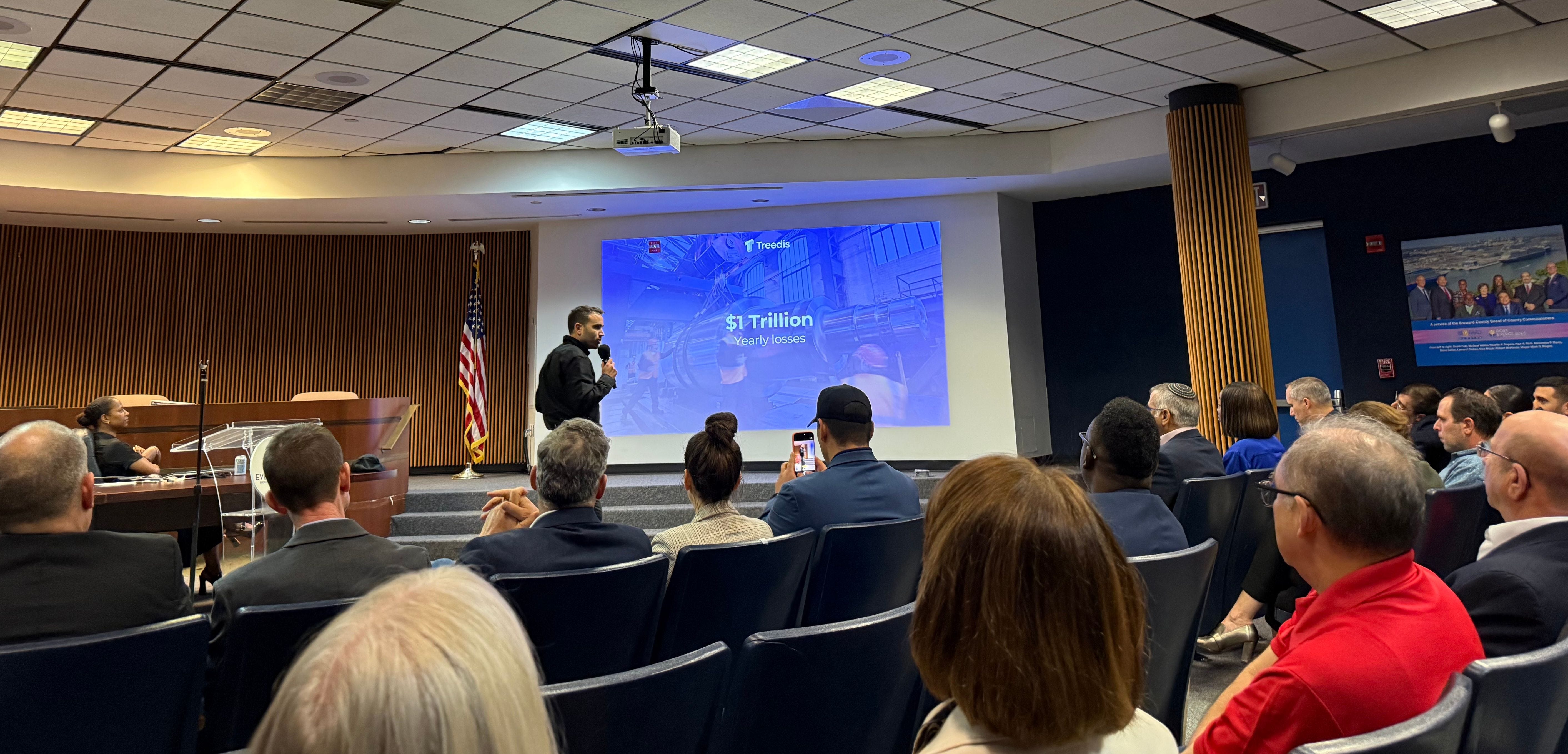
Startups presenting at a recent event hosted by Office of Ocean Economy.
Shipping and ports have attracted nearly $7B in venture funding since 2016, making it one of the most funded segments in the blue economy. Funding peaked in 2022 at $2.6B following pandemic-era supply chain chaos, but then fell sharply.
Most of that capital hasn’t flowed into ports themselves. It’s gone to platforms sitting around them like digital freight forwarders, visibility platforms, and voyage optimization players.
Ports, by contrast, have largely remained fixed infrastructure. That’s what makes the Ashdod model interesting. And it turns out they’re not alone:
🇳🇱 The Port of Rotterdam has been running PortXL, a maritime accelerator that connects startups directly with port operators and corporate partners to test decarbonization, logistics digitization, and efficiency solutions inside live operations.
🇸🇬 In Asia, the Maritime and Port Authority of Singapore runs PIER71 and the Smart Port Challenge, a global call for startups to solve real port and maritime problems, with structured access to port stakeholders and infrastructure.
🇺🇸 In the USA, the Port of San Diego launched its Blue Economy Incubator back in 2016. Rather than focusing purely on cargo optimization, it has funded and piloted technologies across coastal resilience, environmental monitoring, aquaculture, and clean maritime systems.
Each port’s model looks slightly different. But the pattern is the same – instead of waiting for innovation to arrive as a vendor pitch, they’re actively creating space for it.
Ports already anchor thousands of jobs, including logistics, customs, and maritime operations. But when they start embedding startups and testing new technologies, you layer in cybersecurity, robotics, AI, drone systems, emissions analytics, and data engineering.
They’re natural innovation platforms when the right connections are in place. Ports can evolve from static gateways for goods to becoming platforms that generate new companies, skill sets, and economic clusters.
Thanks for reading Blue Tide. As always, I’d love to hear what you think about what was covered in this edition.
🟦 Zané