


ShoreLock is a Miami-based coastal technology company working on beach erosion. Its seaweed-based treatment, made from sargassum, is designed to help beaches hold their sand longer between nourishment projects, the periodic efforts that bring in new sand.
Co-founder Blayne Ross leads strategy, partnerships and growth, working alongside scientist Dr. Troy Scott. I spoke with Blayne about the problem ShoreLock is built to solve, how the treatment works, what the results show so far, and where he sees coastal protection heading.
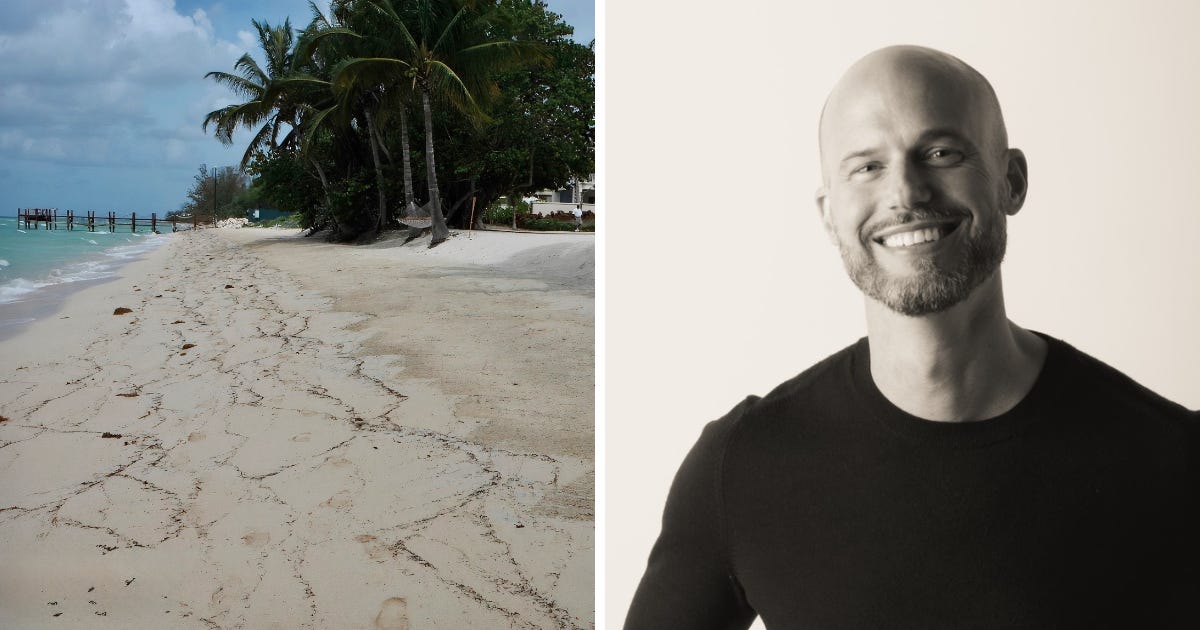
Blue Tide: What problem is ShoreLock solving, and why has it been so hard to fix historically?
Blayne Ross: I grew up on the coast, and I remember it took ages to walk from the dunes to the water. You’d walk out and wonder if you’d ever get there. Now there are places where boardwalk stairs end in mid-air, because the sand they used to land on is gone.
That’s the visible version we all see. A 2018 satellite study in Scientific Reports found that about a quarter of the world’s sandy beaches are eroding faster than half a meter a year. Globally, nearly half were stable and more than a quarter were gaining sand. Florida is a different story. The state’s Department of Environmental Protection data show more than half of Florida’s sandy beaches are critically eroded, meaning erosion is threatening homes, roads, recreation or wildlife. That’s a big deal for all of us.
It’s hard to fix because the standard answers each come with a cost. A seawall protects what’s behind it and can make the beach in front of it worse if not disappear. Nourishment brings in new sand, and it’s what Florida leans on. It works, but it’s costly and can disappear in one weather event. The state’s beach program drew more than $850 million in funding requests across just the five fiscal years ending 2024-25. That’s a big number. And newly placed beach starts giving sand back to the ocean as soon as the waves find it. One of the first ways you see this is often an escarpment, a cliff of sand at the water’s edge, that can be 6 inches or 6 feet tall. If it’s the latter, it’s a safety problem for people, a barrier for nesting sea turtles, and it slows the beach’s recovery.
I think of a beach as infrastructure. We rebuild a road on a schedule, but we also patch it in between. The beach mostly gets the rebuild, and nobody is thinking about the gap in between. On top of that, the ocean is a hard place to run a controlled experiment, so engineers are cautious about anything new, and for good reason. That caution is part of why the same tools have been used for so long, and it is now holding us back.
Miami-Dade’s own Sea Level Rise Task Force saw this coming. In 2014, it told the county it needed “not just to update, but in a sense, to reinvent our urban infrastructure,” and that “we need to start the process now.” If the beach is infrastructure, it belongs in that sentence. Reinventing it means filling the gap between rebuilds with tools that keep sand in place, and that only happens if we test them in the water, learn fast, and scale what works. Twelve years later, the beach is still waiting for its reinvention. It’s time we respond and start piloting new methods.
Blue Tide: How does ShoreLock work, and what does a project typically look like from start to finish?
Blayne: The idea came out of Dr. Troy Scott’s research. He’s a microbiologist with a Ph.D. from the University of Florida, and for years his work had been about how contaminants attach to sand. Someone challenged him to apply that to beach sand, and he came back with a prototype formula in a matter of days.
It’s personal for both of us. Troy and I grew up on the coast, and we both have family and friends who worry about what’s happening to it.
For a moment I want you to think of a sandcastle. Too dry and it falls apart, too wet and it slumps. Somewhere in between, the water holds the grains together. ShoreLock® is a sargassum-based compound, in dry or liquid form, that helps sand hold that balance. When a wave pulls back, the water drains through the beach instead of dragging sand with it. We work with the sand that’s already on the beach. We aren’t buying and shipping in new sand.
Our projects start with a baseline: a topographic survey by a third-party surveyor, plus environmental, sand and water sampling. Then we apply the compound along the mean high-water line, about a foot below the surface, by hand or with light machinery. No structures, no dredging, no beach closure. People walking on the beach won’t notice a difference.
It breaks down in about six months, so a project doesn’t end at one application. We resurvey over the following months, then reapply about every quarter, well before it wears off. Nourishment rebuilds a beach, and we’ll still need it for that. This is the upkeep in between: a small crew with light machinery, at far lower cost than bringing sand in.
It does have limits. It needs sand to work in. In the Caribbean, some developers have built beaches at the rough edges of an island by dumping sand onto hardpan, a hard shelf of rock or compacted material. That hard layer has to sit at least 24 to 30 inches below the sand so the water can drain through it. We learned that in the Dominican Republic. It’s a Caribbean problem more than a Florida one.
The other limit is weather. We designed ShoreLock for the 99 percent of the time when a beach needs to behave like sand and run through your fingers like sand. We didn’t design it for the 1 percent, a major storm. A storm that can knock down a house, concrete or wood, is going to move sand no matter what’s been put on the beach. We haven’t tested it in high-wave environments yet, so I won’t make claims there. I’d like to see it in severe weather, and if it performs well, we’ll say so with the data. No treatment can promise a beach won’t wash out, and I’d never say ShoreLock does either. The real test will be how much we can reduce washout.
Blue Tide: Walk us through the results so far. What has given you the most confidence in the technology?
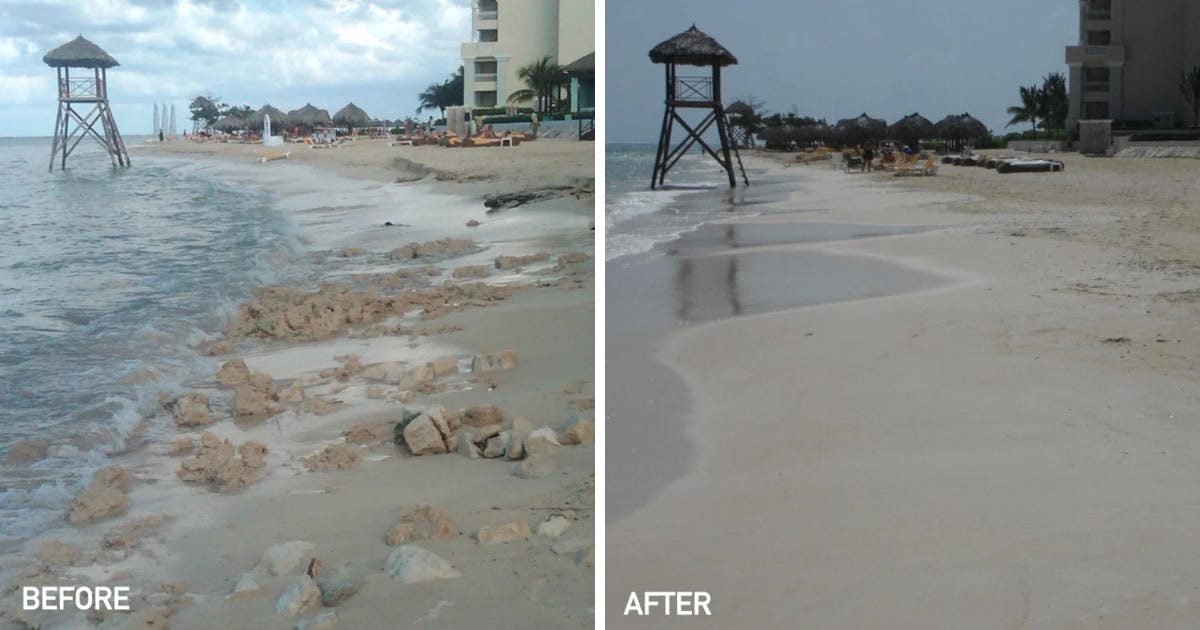
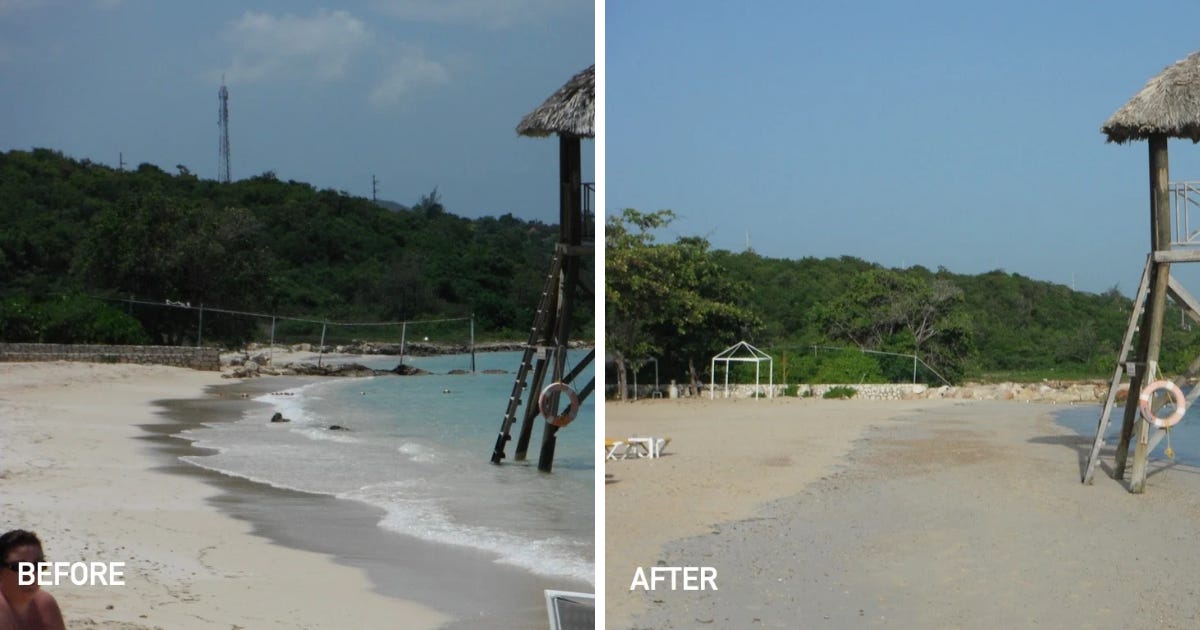
Blayne: The result I care about most is the simplest one. On the Caribbean beaches we’ve treated, the escarpment, that cliff of sand at the water’s edge, is gone. Where there was sand offshore for the waves to bring back, some beaches also gained sand. Where there isn’t, there’s nothing for the beach to pick up.
Our first project was in the Bahamas in 2009, and the work has since spread across the Caribbean. Most of those projects were environmentally monitored by us, with outside surveyors doing the topography. The exception was Jamaica. That project was funded by the European Union, the UN Environment Programme and the Government of Jamaica, and scientists from the University of the West Indies ran the environmental monitoring. It was a biological study, not a beach-gain study. They checked water quality and the sand and marine life at the treated beaches. Water quality was normal, and ShoreLock didn’t remove the sand fauna, though some species changed in abundance.
In the lab at the University of Florida PERC, treated sand was up to 85 percent more cohesive when wet and behaved like ordinary sand when dry. It tested non-toxic to marine organisms under EPA methods. We published those results in the Journal of Coastal Research in 2025.
What gives me the most confidence is the side by side photos. When you can stand on a beach and see a treated stretch next to an untreated one, you don’t need me to explain it.
What we don’t have is a project in Florida. Everything so far has been in the Caribbean, and that’s the piece we’re working to change.
Blue Tide: Who are your primary customers, and how does the business model work?
Blayne: We serve three groups, and they each care about different things.
Resorts and hotels, mostly in the Caribbean so far, are the ones we’ve worked with most. For them the beach is the product, and a shrinking beach shows up in every guest photo and review, it can make or break the experience for guests. Governments, from local municipalities to national agencies, care about public safety, habitat and keeping beaches open, and the escarpment touches all three. The third group is private beachfront property owners, whose homes and land sit right behind the sand and fear losing their asset.
The ShoreLock model is a program, not a one-time sale. For now a customer starts with a baseline survey and an initial application at a forecasted fixed fee, based on the material we estimate the beach needs. If the results lead the customer to want more material to achieve a different result than we forecast, that’s priced separately. A monitoring period follows, so they can see what changed. We usually start with a first project sized to what the customer wants to see on their own beach before committing to more. After that comes the recurring part: a maintenance contract, with reapplication about every quarter. Eventually we won’t need the monitoring layer, but for now it’s a component of each project.
I think the real challenge for the owner or municipality is that a truck fill or nourishment project is a capital line with a start and an end. What comes after it, the slow sand loss between placements, usually isn’t on anyone’s budget. ShoreLock puts it there, as an operating expense to account for in the gap. We are talking about what nobody wants to discuss.
Blue Tide: If ShoreLock reaches its full potential, what does coastal protection look like in ten years?
Blayne: Ten years out, I’d like coastal protection to look boring. Scheduled, funded, unremarkable. The way we treat roads.
To get there we need to evolve the plan, budget for the protection, and acknowledge the planning gap up until this point. The beach protects our homes and the home is usually the largest thing a family owns, and it’s where their wealth actually sits. Some of this country’s biggest cities, and a lot of its concentrated wealth, sit on the coast. Florida’s own economists put roughly $1.1 trillion of property value in the state’s high-risk flood zone, about a quarter of all the property value in Florida. The same office found that beaches are the single biggest reason visitors come here, and that the state’s beach program returns more than five dollars in tax revenue for every dollar it spends.
So the beach isn’t an amenity. It’s the thing standing in front of all of that. And right now we fund it like a series of emergencies, rebuilding only after the loss instead of slowing the loss down. We go to the doctor for preventative measures and only go to the hospital or ER during an emergency. Why are we treating the beaches any differently?
The change I want to see is that maintenance becomes a normal category. Today there’s no line item for treating the sand you already have. You can fund placing new sand, and you can fund building a structure. There’s nothing in between. Until that category exists, every engineer and every county politician has to invent it from scratch to try anything new, and most of them won’t. We have the technology available now. It’s a procurement problem.
If that changes, a county would have a maintenance program for its beaches the way it has one for its drainage or trash removal. We aren’t replacing what’s being done now, we are part of the tool box of solutions available to get the job done better.
For us, the next ten years start much smaller than that. We need a project in Florida, with data collected by the State, on a beach people can go stand on.
To learn more about the company, visit shorelock.com, and to start a conversation with Blayne, reach him on LinkedIn.
This article is part of a spotlight series on Blue Tide, which shares the deeper stories about the people and startups shaping ocean technology. If you know someone who would like to be featured, send me an email.