


The blue economy is having a moment. Capital is moving in, conferences are full, and the science is strong. And yet the most promising ventures keep stalling out between proven and commercial.
Brooke Lynn Elzweig has a name for the space where that stalling happens. She calls it the brackish zone, and she built Brackish Strategies specifically to meet companies there. Named after the estuarine mixing ground where salt and fresh water converge, the brackish zone is ecologically one of the most productive environments on earth precisely because of the confluence. Brackish operates on the same logic.
Brooke is an environmental engineer by training, a marine scientist and restoration practitioner by field experience, and a business strategist by necessity. She founded Brackish Strategies in November 2025 from her base in Delray Beach and has already expanded client work globally. The firm is a boutique strategic advisory supporting ventures across coastal resilience and blue infrastructure, water systems and resource infrastructure, and climate-enabling materials and industrial decarbonization.
Her core thesis is that every industry eventually drains to the sea. Brooke's argument, shaped by years working across federally funded projects and privately financed marine work, is that the bottleneck is not innovation or ingenuity. It's access to capital, customers, and strategic partners. More specifically, it's the translation layer between them.
I sat down with Brooke to talk through what that gap actually looks like, why it persists, and what it would take to close it.
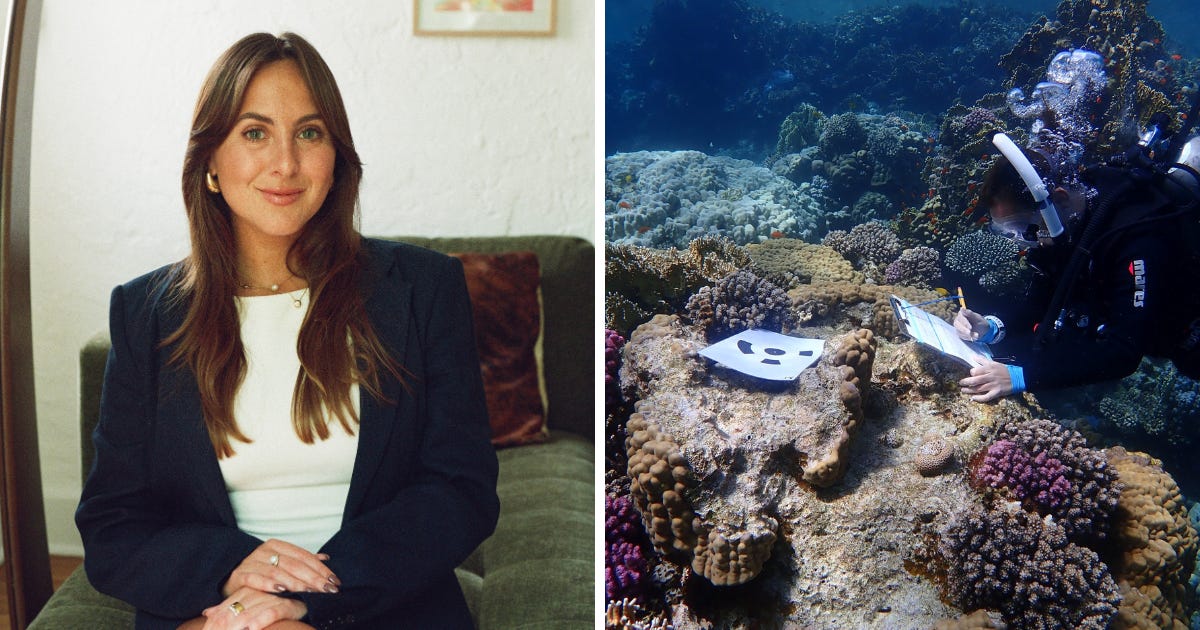
Blue Tide: The valley of death is a concept that exists across deep tech, but what makes ocean tech specifically harder to move through than other sectors?
Brooke Lynn Elzweig: Out of sight, out of mind. Honestly, that’s the simplest way I can put it. Land-based technologies are accessible… you can visit a factory, touch a product, watch a field trial. The ocean is remote by definition, expensive to operate in, and nearly impossible to demonstrate in a conference room. That physical inaccessibility creates an epistemic gap for investors who haven’t spent time on or in the water.
But the harder structural problem is that ocean tech doesn’t fit cleanly into any existing investment category. It’s not cleanly climate, not cleanly infrastructure, nor cleanly biotech. It touches all of them and maps neatly onto none of them. So when an ocean founder walks into a room with a generalist investor, the first challenge isn’t the technology, but it’s the vocabulary. Investors pattern-match against things they already know. Ocean tech doesn’t match any of those patterns yet, and that mismatch is where momentum dies before it ever starts.
BT: You work with ventures that are technically de-risked but still struggling to close funding. What does that look like from the inside?
Brooke: From what I’ve seen, it looks like a founder who has done everything right and still can’t get a term sheet. They have peer-reviewed validation, a working prototype, a pilot with a municipality or government agency, letters of intent, etc. On paper, they’re exactly what an investor should want, but the commercial narrative hasn’t caught up with the technical progress. They can tell you precisely how the technology works but struggle to answer why this market, why now, and why them in a way that lands with someone whose primary question is what is my path to return. The technology is de-risked, but the story isn’t.
There’s also a relationship problem that I’ve seen. Ocean founders tend to be embedded in scientific and research communities, not investor networks. So when the time comes to raise, they’re starting from cold outreach rather than warm relationships built over years. The funding gap is real, but the access gap underneath it is just as significant. Relationships matter!
BT: Most ocean founders come from science and engineering backgrounds. Where does the breakdown happen when they start talking to capital providers?
Brooke: It’s funny… I got my engineering degree and I’ve watched this play out since my undergraduate days. Scientists and engineers think in detail. They’re trained to lead with how something works, to qualify their claims, and to present the complexity with integrity. That’s exactly what makes good science. They’re problem solvers and think in processes.
But investors need to hear the market before they hear the mechanism. They want to know: What’s the size of the opportunity? Who’s paying for this today? Why is now the right moment? Those questions have to come first, and most technical founders reach them about fifteen minutes into a pitch rather than just opening with those numbers.
There’s also something else I’ve noticed. Investors invest in the founder, not the solution. Integrity and competence matter a lot. There’s no shortage of big ideas in the ocean space, and honestly, a whole lot of vaporware. What investors are really hunting for is someone who thinks differently, sees something others have missed, and is solving a problem that’s genuinely real… with the unit economics and market validation to back it up.
BT: There are more ocean-focused funds now than there were five years ago. Does that mean the gap is closing?
Brooke: I think it means the market is finally starting to prove itself. I mean, S2G Investments just closed a $1 billion fund with ocean systems as a named pillar. Backed by pension funds, family offices, and institutional investors across four continents. That’s not a niche bet anymore; that’s a signal. The ocean is becoming a serious investment theme, not just a mission-driven one or a way for corporates to clear their ESG conscience.
But more funds and a closing gap are two different things. Less than 2% of the $550 billion in annual investment needed for a sustainable ocean economy was actually deployed in 2023. So the infrastructure for capital is being built, but the volume flowing through it is still a fraction of what the sector requires.
The real question, though, is whether these ventures can actually prove returns for LPs. The capital is starting to show up, but now the companies actually have to perform. That’s the next chapter, and honestly, the most important one. If the early cohort of well-funded ocean ventures delivers, the floodgates open. But if they don’t, this moment backpedals. The market has proven itself enough to attract serious capital, but now it has to prove itself enough to keep it.
BT: If you could change one structural thing about how ocean ventures get funded, what would it be?
Brooke: I’d change the taxonomy around ocean investment. How ocean ventures get categorized by capital providers has downstream effects on everything from due diligence to return expectations to which investors even see the deal.
Right now, ocean investment gets sorted into an ESG or impact bucket by default. That triggers a different type of investor relationship, a different set of return expectations, and often a fundamentally different conversation than a company building coastal infrastructure or water technology should be having. These are real assets with real revenue and markets. The ocean is not a cause; it’s an economy (and a big one, at that).
When a marine construction platform or a coastal resilience company gets evaluated through the same lens as a donation to a conservation nonprofit, the conversation starts in the wrong place and almost always ends there too. Fix the taxonomy and you fix the routing: which investors see these deals, how they evaluate them, and what kind of capital actually shows up. That single shift would unlock more momentum than any new fund or blended finance mechanism could on its own.
The over-reliance on political and federal funding cycles is real too, and it’s a related problem. When the baseline assumption is that ocean ventures need a government grant to survive their early years, it signals to private capital that these businesses aren’t investable on their own terms. Breaking that assumption starts with changing how the sector gets categorized and who gets invited into the room to fund it.
Brooke works with ventures in what she describes as the growth-stage sweet spot: companies with real traction, often in the $5 to $50 million revenue range, that haven’t yet broken through to broader institutional visibility. They’re investable but often invisible.
If that sounds like your company, or if you’re a capital provider looking to better understand the space, reach out to Brooke at brooke@brackishstrategies.com or visit brackishstrategies.com.
This article is part of a spotlight series on Blue Tide, which tells a deeper story about the people and solutions shaping the blue economy. If you know someone who would like to be featured then send me an email.
That’s great read am very interested in taking a scuba diving course here soon. I found your article to be divine with culture and history facts. Thank you lady’s for the read.